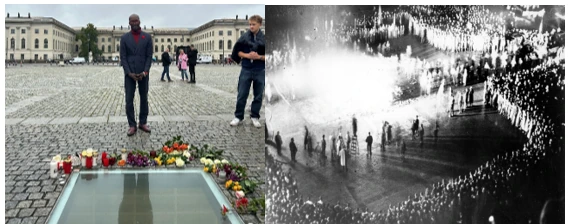
On the night of May 10, 1933, in Berlin’s neighborhood of Bebelplatz, thousands gathered, many carrying torches. University students loyal to the nascent Nazi regime, along with their professors, had brought over 20,000 books labelled “un-German” to be publicly burned. Such scene was the display of a violent tactic whose intent was to suppress dissident voices and instill fear, encourage conformity, and emphasize that the authority figures (in this case, the Nazi regime) holds the power to determine what counts as acceptable truth.
Historical Context
After Adolph Hitler became Chancellor in January 1933, the Nazi regime quickly moved to suppress opposing political voices, expressions of dissent, and ideas deemed un-German. Book burning was part ritual, part propaganda, and part psychological warfare: a spectacle meant to unify Nazi supporters around the destruction of ideas as much as the books themselves.
Beyond the burnings, there was formal censorship: authors and books were listed on indices of forbidden literature; sale and distribution of certain works were prohibited; librarians, publishers, and booksellers risked reprisals if they refused to comply. Over time, German public libraries, schools, and universities were cleansed of “non-Aryan” and ideologically suspect literature.
Jewish authors, socialists, political activists, and individuals with so-called “undesirable” backgrounds saw their works consigned to the flames. Among them were Albert Einstein, Sigmund Freud, Karl Marx, Helen Keller, Bertolt Brecht, Heinrich Mann, and many others whose ideas challenged the Nazi regime’s rigid worldview. Institutions such as the Institute for Sexual Science in Berlin, renowned for its pioneering research on sexuality, gender, and human behavior, were ransacked, their libraries looted, and their collections publicly burned, symbolizing the regime’s broader assault on intellectual freedom and cultural diversity.
A Déjà Vu: Book Ban in the U.S. Today
Access to books should not be a luxury; it’s central to education, democratic engagement, empathy, and identity formation. Books are not just containers of stories or information: they are vessels of worldviews, identity, and cultural memory. Controlling books means controlling what people are allowed to think, question, or imagine. When only “approved” narratives are allowed, education leans toward propaganda. Authors who challenge the status quo, who ask difficult questions, or who represent marginalized groups become targets.
While the U.S. has constitutional protections for free speech and expression, the practice of challenging, restricting, or removing books in schools and libraries is nothing new, though recent years have seen a sharp surge. This trend underscores the ongoing conflict between constitutional ideals and local governance, where educational content often becomes a battleground for cultural and political values. Below are two current cases in the United States involving the regulation and restriction of books in public and educational settings.
Book Banned Litigation in the United States
- Utah HB 29 (2024‑2025): Utah’s HB 29 is one of the most extreme books banning laws currently in effect. The law mandates statewide bans and has resulted in the first instance of a state releasing an official list of books that are illegal to stock on school shelves. The law builds on 2022’s HB 374, aka the “Sensitive Materials in Schools” Act. HB 374 banned “sensitive materials” from public schools, which it defined as “indecent or pornographic” materials under existing state statute. The law caused book bans in Utah to jump from just 12 banned books in the 2021-2022 school year to 281 banned books the next year; it was used to justify the bans of popular titles The Bluest Eye by Toni Morrison, and Out of Darkness by Ashley Hope Perez.
- Mahmoud v. Taylor: In this Supreme Court case, families in Montgomery County, Maryland sued the school district because they argued that parents should be able to opt their elementary school children out of lessons using books with LGBTQ themes based on religious objections. The case raises questions about free exercise of religion vs. inclusive education. The U.S. Supreme Court recently ruled that parents do have the right (under certain conditions) to opt their children out of such lessons.
It is important to remember that the First Amendment and several court rulings provide critical protection for public discourse, activism, and the work of librarians and authors. However, even in societies that uphold free speech, the same impulses that fueled the Nazi book burnings, fear of “the other,” and of evolving social norms, can manifest in more subtle and systemic ways. In the contemporary United States, the rising authoritarian tendencies and efforts to enforce a singular ideological narrative reflect a troubling erosion of democratic pluralism.
Lessons from Bebelplatz
Books are among the most potent tools for shaping public consciousness. Whether through brutal burnings in Nazi Germany or the more bureaucratic, decentralized book bans in the U.S., the attempt is similar: to define which stories count, whose voices are heard, and which truths are acknowledged. In a world where literacy is more than the ability to read, where it is about identity, empathy, dissent, and democracy, defending the right to read becomes a necessary act. The lessons from Bebelplatz are not just historical; they are present challenges.